
Salary Review
All Saco-S members at SLU participate in salary-setting talks
The 2026/27 salary review for Saco-S members
For Saco members, the central collective agreement RALS-T applies. This agreement is open-ended and aims to promote long-term and stable salary formation. It is a process-based agreement without predetermined salary increases and contains no individual guarantees for pay rises.
As a general rule, the salary review is conducted through salary-setting talks, during which the manager and employee agree on a new salary.
What Are Salary-Setting Talks?
All Saco members at SLU (except doctoral students) participate in salary-setting talks (LSS) under the provisions of the central RALS-T agreement. Since the employee and the salary-setting manager are best placed to assess performance and results in relation to the content of the work, salary determination is carried out through a direct dialogue between them.
As the agreement contains no predetermined salary increase percentages, discussions with employees should not focus on percentages, salary pools, or fixed increases. The focus should be on salary and salary level.
Salary-setting talks that result in a disagreement are referred to a local negotiation. Such negotiations involve the salary-setting manager, the Head of Department (where relevant), an HR specialist, and Saco. The primary focus is a review of the process and dialogue between the manager and employee and, in certain cases, the salary level itself.
The parties have agreed that employees who choose not to participate in salary-setting talks will have their new salary determined unilaterally by the Head of Department or equivalent manager. Failure to respond to an invitation from a manager, or failure to accept a meeting invitation, is also considered a decision not to participate.
Heads of Department or equivalent managers may also make larger salary adjustments where salaries are deemed incorrect. Such adjustments are normally handled outside the annual salary review process.
Doctoral students' salary progression is governed by the doctoral salary scale, which is reviewed and renegotiated annually. Doctoral students do not participate in salary-setting talks. Veterinary trainees undertaking specialist training are treated in the same way as doctoral students.
Salary Levels
Salary should be used as a tool to achieve the University's objectives and to recruit, motivate, develop and retain employees with the competencies needed in both the short and long term.
Salary should be determined on objective grounds such as responsibility, the complexity of duties, other requirements associated with the role, and the employee's skills and performance in relation to operational objectives. Salaries should be individual and differentiated.
The process depends on regular dialogue between manager and employee and on performance and development reviews being conducted and linked to the salary-setting talks.
The parties agree that salary-setting talks should focus on salary and salary level. Is the employee's salary appropriate in relation to their duties, responsibilities, complexity of work and performance? Under the Saco model, discussions about salary increases in kronor, percentages, or salary pools are not relevant in this context.
The parties also agree that the University's financial situation must be taken into account during the salary review process. Each faculty and department, or equivalent unit, should therefore base its assessment of new salaries on its financial circumstances, as well as the prevailing salary structure and salary levels within SLU.
Salary-Setting Talks: Process
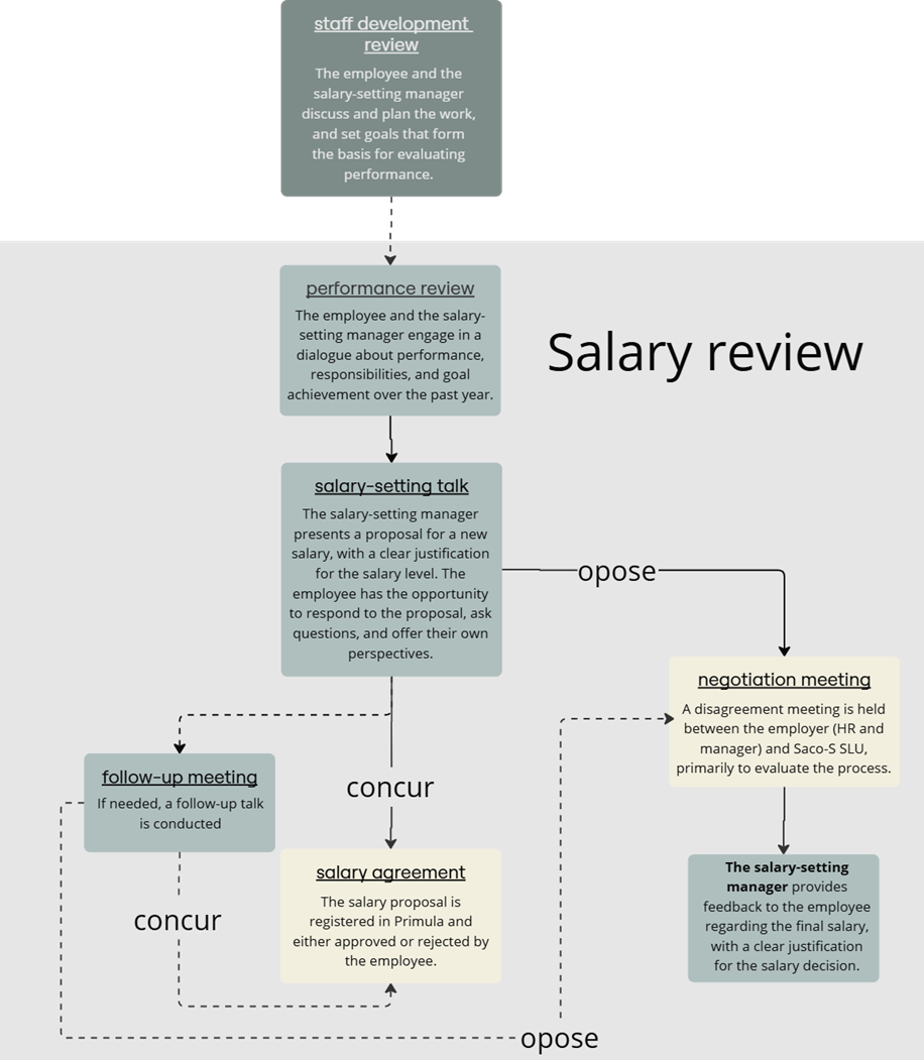
The salary review model is based on two salary-setting talks between the salary-setting manager and the employee, followed in some cases by a confirmation or follow-up after a period of reflection.
Salary-Setting Talk 1 focuses on the employee's results and performance in relation to the content of their work, as well as their current salary position.
Salary-Setting Talk 2 is a follow-up meeting during which the salary-setting manager presents a proposal for a new salary. The employee has the opportunity to ask questions and provide feedback on the proposed salary. This talk takes place only after all first-round talks have been completed.
If the manager and employee reach agreement, the salary is formally established during Salary-Setting Talk 2 when both parties sign the Agreement on New Salary form. Employees who require time to consider the proposal may normally submit the signed form within, for example, one week.
In some cases, a third salary-setting talk may be necessary to reach agreement on a new salary. More commonly, however, a simple confirmation of the employee's position on the proposal is sufficient.
Saco members have the right to declare themselves in disagreement with the proposed salary. The matter is then referred to a negotiation between Saco-S at SLU, the Human Resources Division, the salary-setting manager, and the Head of Department or equivalent manager.
The purpose of this negotiation is to review whether:
- The talks were conducted according to the agreement between the parties.
- The process functioned correctly.
- The assessment of work performance was carried out appropriately.
- No formal procedural errors occurred.
The salary level is discussed only from the perspective of objective assessment and where the salary appears unreasonably or unusually low.
Content of the Talks and Necessary Preparation
The salary-setting talks should be a dialogue concerning the employee's work performance, achieved objectives, and current salary level. The purpose of the talks is to help the employee understand the basis on which salary decisions are made and what they can do to influence their future salary development.
For the talks to be productive, both the employee and the salary-setting manager should prepare by reflecting on the employee's performance in relation to organisational and individual objectives during the previous year.
As support during both the preparation stage and the talks themselves, employees and managers can use the document Criteria for Performance Evaluation. It is also important that performance and development reviews have been documented and include clearly defined objectives.
The evaluation criteria are intended as a basis for discussion. Depending on the nature of the work and the organisation's objectives, different criteria may carry different weight. For example, teamwork may be particularly important in some areas, whereas initiative and judgement may be more important in others.
If a department or division chooses to weight criteria differently or introduce additional criteria, these arrangements must apply to all employees and be communicated clearly at an early stage of the salary review period. The fundamental principle is that employees should know in advance how their performance will be assessed during the next salary review.
What Characterises a Good Talk?
- A constructive dialogue in which both parties have the opportunity to contribute.
- A clear explanation from the manager regarding the assessment of both performance and salary.
- An opportunity for the employee to provide feedback on the manager's assessment.
- Clear guidance from the manager regarding what the employee needs to improve or develop in order to positively influence future salary progression.
Important Points to Remember
Salary-setting talks involve a direct dialogue between you and your salary-setting manager.
Take the time to consider any salary proposal you receive. You are not expected or required to sign an agreement immediately during Salary-Setting Talk 2.
The final agreement should be concluded only after the manager has completed all salary-setting talks.
This allows the employer to make any necessary adjustments following the initial talks without the overall salary structure becoming fixed prematurely through already concluded agreements.